


Revenue-based financing (RBF) is a funding option where businesses repay investors by sharing a fixed percentage of their monthly revenue. It’s a flexible alternative to traditional loans, especially for eCommerce businesses with seasonal sales or fluctuating cash flow. Here's what you need to know:
- How It Works: Businesses receive upfront funding and repay based on revenue, with total repayment capped (e.g., 1.5x the loan amount). Payments vary with sales - higher in strong months, lower in slow months.
- Who Benefits: Ideal for eCommerce businesses needing quick capital for inventory, marketing, or growth without giving up equity or personal guarantees.
- Key Stats: The RBF market grew from $901.41M in 2019 to a projected $42.3B by 2027, driven by eCommerce growth and small business cash flow challenges.
Quick Pros and Cons:
| Advantages | Disadvantages |
|---|---|
| Flexible repayments tied to revenue | Higher effective APR compared to traditional loans |
| No equity loss or personal guarantees | Requires consistent revenue for eligibility |
| Fast approval and funding | May not suit businesses with tight profit margins |
RBF works best for businesses with steady revenue and clear growth plans. If your business can manage repayments as a percentage of sales, it could be a smart way to scale without losing ownership.
The Pros and Cons of Revenue Based Financing
1. Onramp Funds
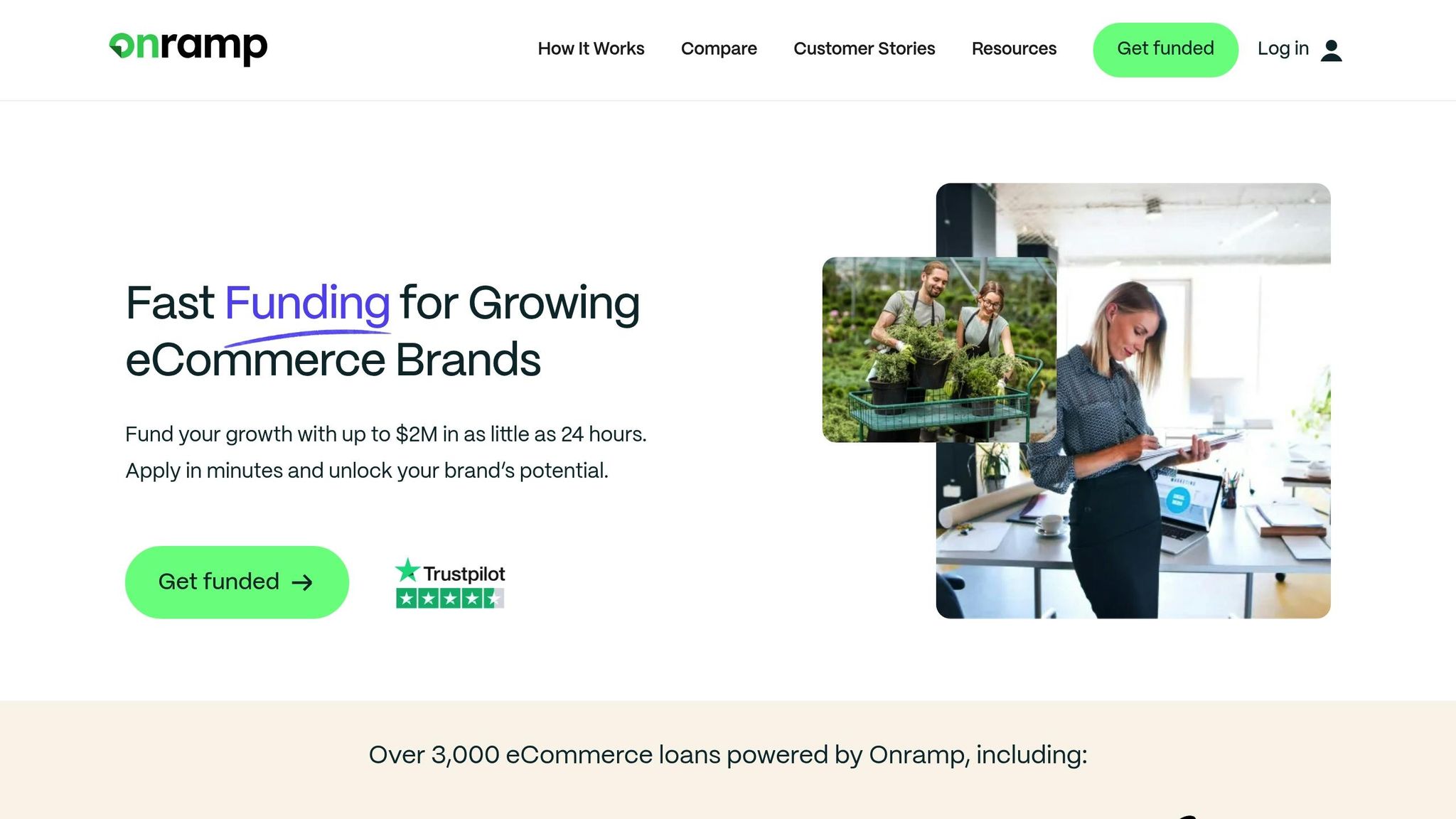
Operating out of Austin, Onramp Funds is dedicated to supporting online retailers, offering funding of up to $2 million. They promise an impressively quick turnaround, with capital delivered in as little as 24 hours.
Repayment Flexibility
Onramp Funds offers a repayment structure that adapts to the ups and downs of your sales. Payments are automatically adjusted based on how your business performs. For instance, during busy seasons when sales are high, businesses contribute more toward repayment. Conversely, during slower periods, payments decrease accordingly. By aligning repayments with sales cycles, Onramp helps businesses avoid the stress of rigid payment schedules.
"Onramp has simplified cash flow by automating everything: easy to request, set it and forget it payments - quick and fast!"
– Torrie V., Founder and Owner of Torrie's Natural
Cost of Financing
The cost of financing with Onramp Funds is transparent, with fixed fees ranging from 2% to 8%. Unlike traditional loans that often rely on credit scores or collateral, Onramp evaluates repayment ability based on actual business revenue. This revenue-based model is ideal for eCommerce businesses seeking short-term funding for needs like restocking inventory or running digital marketing campaigns. Plus, a shorter payback period results in a more competitive annual rate, making it a practical solution for businesses focused on immediate growth.
Eligibility Requirements
Onramp Funds keeps its eligibility requirements straightforward. eCommerce businesses need a minimum of $10,000 in monthly sales to qualify. Instead of requiring extensive paperwork or high credit scores, Onramp pulls sales data directly from major platforms. This automated, data-driven process allows for quick decisions and eliminates much of the hassle associated with traditional loan applications.
"Applied, got our offer, and had cash in our bank account within 24 hours. Their Austin, TX based team was very professional and helped me deploy the cash to effectively grow our business."
– Nick James, CEO Rockless Table
Suitability for eCommerce
Onramp Funds is tailored specifically for eCommerce, integrating seamlessly with platforms like Amazon, Shopify, TikTok Shop, WooCommerce, BigCommerce, Squarespace, and Walmart Marketplace. This focus allows them to address the unique challenges of online retail, whether it’s funding inventory, improving logistics, ramping up marketing efforts, or launching new products.
The results speak volumes. Onramp Funds reports that their customers see an average of 60% revenue growth within 180 days of receiving funding, and 80% of clients return for additional financing.
"Onramp offered the perfect solution with revenue-based financing to secure the capital we needed to invest in inventory and pay it back at a reasonable time frame once we made sales. The process was quick, easy, and the support was great."
– Jeremy, Founder and Owner of Kindfolk Yoga
sbb-itb-d7b5115
Pros and Cons
Here’s a breakdown of the main benefits and challenges of revenue-based financing for eCommerce businesses:
| Aspect | Advantages | Disadvantages |
|---|---|---|
| Repayment Structure | Payments adjust to sales - higher during busy seasons and lower during slow periods. | Managing cash flow becomes critical as a fixed percentage of revenue goes toward repayments. |
| Financing Speed | Quick approval and funding, often within days, unlike traditional loans. | The amount of funding might not cover larger capital needs. |
| Business Control | No equity dilution - retain full ownership and control. | Some agreements may limit certain business decisions. |
| Eligibility | Approval focuses on revenue performance rather than credit scores. | Mostly available to digital-first businesses like eCommerce companies. |
| Cost Structure | Transparent fixed fees, usually between 2% and 8%, with no hidden charges. | Can result in a higher effective annual percentage rate (APR) compared to traditional loans. |
| Collateral Requirements | Often unsecured, with no need for personal guarantees. | Typically requires an established track record, making it less accessible for newer businesses. |
This table outlines the trade-offs involved, which are further explored below. One of the standout features is the flexible repayment structure. Payments naturally align with sales trends, increasing during peak times and easing during slower periods, which can help manage cash flow more effectively.
However, the higher effective APR can be a drawback, especially for businesses with tight profit margins. A larger portion of revenue going toward repayments might create challenges, particularly for companies experiencing rapid growth or fluctuating sales. Fast-growing businesses may face liquidity issues due to increased repayment amounts, while those with slower growth could see extended repayment timelines.
For eCommerce businesses, success with this funding model often depends on maintaining strong gross margins and using the capital for initiatives that yield high returns. Revenue-based financing tends to work best when balanced between leveraging growth opportunities and managing the associated costs.
Conclusion
Revenue-based financing (RBF) can be an attractive funding solution for eCommerce businesses, but its suitability depends heavily on your revenue stability and cash flow. To determine if RBF aligns with your growth strategy, take a close look at your revenue trends, cash flow consistency, and overall business goals.
Experts often highlight how RBF works well for businesses with seasonal sales patterns. Sinoun Chea, CEO and Founder of ShiftWeb, puts it this way:
"Revenue-based financing has been fantastic because it aligns more naturally with the business cycle... This funding model can relieve a lot of pressure on maintaining consistent cash reserves. It's especially beneficial for seasonal businesses or startups scaling rapidly." [1]
However, while RBF offers flexibility, it comes with a higher effective APR that can put pressure on businesses with narrow profit margins. It's not a one-size-fits-all solution, and its advantages need to be weighed carefully against potential drawbacks.
Key considerations include whether your business can comfortably allocate a fixed percentage of revenue toward repayments without disrupting operations. Healthy gross margins are also essential to make this model work. For businesses that meet these criteria, RBF brings several perks: no equity dilution, fast access to funds, and repayment terms that flex with your sales performance.
As Matt Bowman, Founder of Thrive Local, explains:
"For any business owner weighing financing options, capital that aligns with your revenue stream is more than funding - it's a partnership that respects your control." [1]
For eCommerce businesses with steady revenue streams and a clear vision for growth, RBF can provide the financial flexibility to scale without giving up ownership. Companies like Onramp Funds offer equity-free, performance-based financing tailored to your sales, making it a practical option for those ready to expand.
FAQs
What are the key differences between revenue-based financing and traditional loans in terms of cost and flexibility?
Revenue-based financing (RBF) stands out from traditional loans by offering a repayment structure tied directly to your business's revenue. This means when sales slow down, your payments decrease accordingly, providing some relief to your cash flow. On the flip side, traditional loans stick to fixed monthly payments, which can become a burden during seasonal dips or unpredictable income periods.
That said, RBF usually comes with a higher cost of capital, with repayment rates often falling between 20% and 40%. Traditional loans, while offering lower interest rates and more stable costs, lack the flexibility RBF provides. For eCommerce businesses experiencing fluctuating sales, RBF can be an effective way to keep operations running smoothly and support growth - without the stress of rigid repayment terms.
Which types of businesses benefit most from revenue-based financing, and when might it not be a good fit?
Revenue-based financing is an ideal option for businesses with steady or increasing revenue, such as eCommerce stores, SaaS companies, or subscription-based services. The repayment terms, which adjust based on sales, offer flexibility that can help ease financial strain during slower periods. For high-growth businesses, this model is particularly attractive since it supports scaling efforts without requiring them to give up equity.
That said, it’s not the best choice for businesses dealing with unpredictable or highly seasonal revenue. Irregular income can make repayment more challenging. Similarly, companies with low or inconsistent sales may struggle, as their ability to repay hinges directly on their revenue performance.
What should eCommerce businesses evaluate to determine if revenue-based financing is the right fit for their growth plans?
When thinking about revenue-based financing (RBF), eCommerce businesses need to weigh a few critical factors to determine if it fits their growth plans. One major consideration is revenue stability. RBF works best for companies with steady or predictable sales since repayments are tied to a percentage of revenue. This setup provides some breathing room during slower months but requires consistent income to avoid cash flow issues.
Another factor to evaluate is the business's growth stage and funding requirements. RBF tends to be a good fit for companies in a scaling phase - those needing funds for inventory, marketing, or operational growth - while avoiding the need to give up equity. That said, businesses should carefully examine the cost of capital. RBF can sometimes carry higher costs than traditional loans, which could eat into profit margins.
Lastly, it’s important to align RBF with the company's long-term goals and projected growth. While the flexibility of revenue-based repayments can be appealing, it’s crucial to ensure this financing option supports your broader strategy and cash flow management efforts.
Related Blog Posts
Onramp Funds
Funding built around your sales
Connect your store and see what you qualify for. Repay as a percentage of sales, with no personal credit check.
Funding in as little as 24 hours.
