

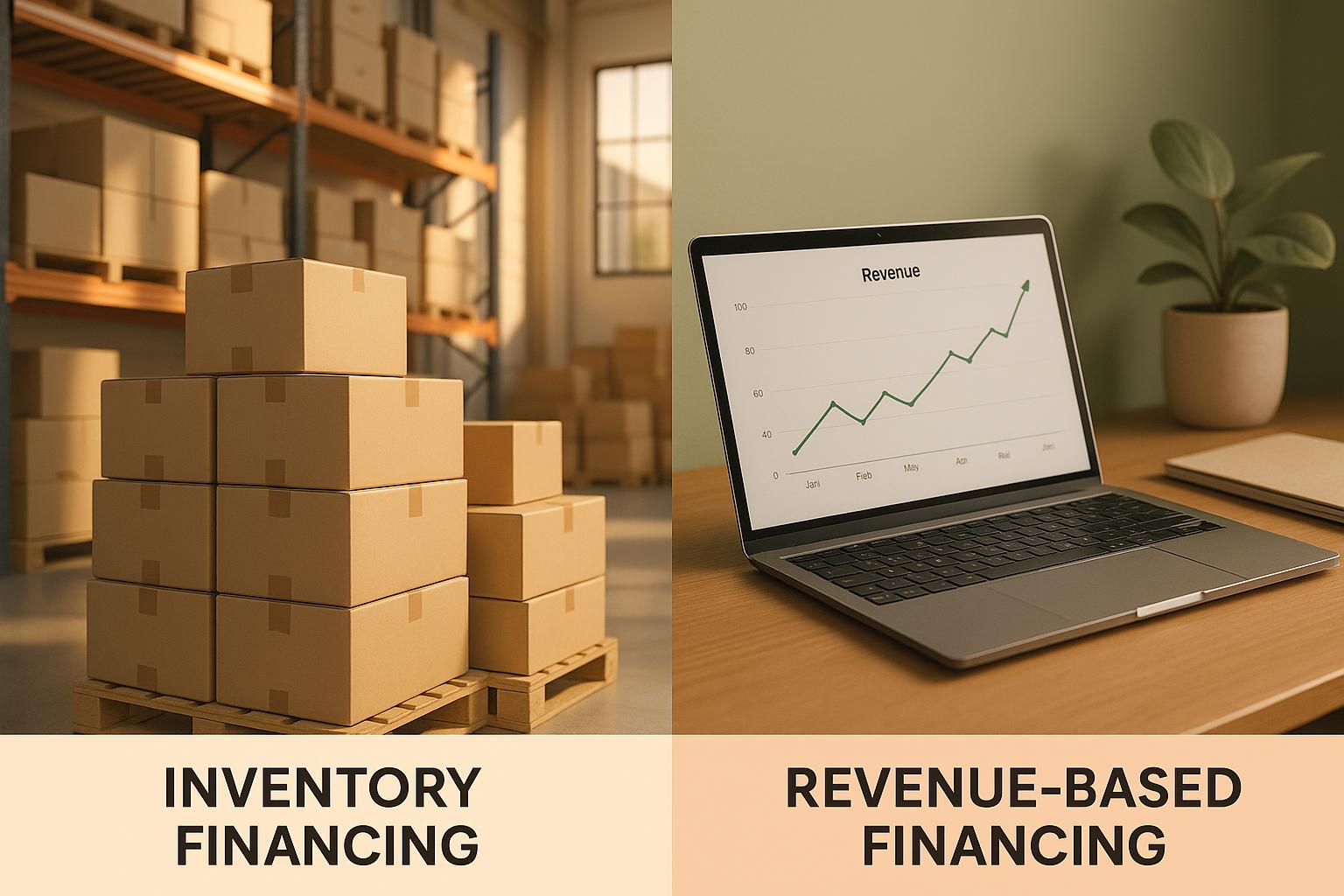
Choosing between inventory financing and revenue-based financing depends on your business's needs. Here's the breakdown:
- Inventory Financing: Uses your inventory as collateral to secure a loan. Best for businesses needing funds to purchase stock and maintain steady inventory levels. Repayments are fixed, making it predictable but less flexible during slow sales periods.
- Revenue-Based Financing: Provides funds in exchange for a percentage of your future revenue. Payments adjust based on your sales, offering flexibility during seasonal or fluctuating revenue cycles. No collateral is required.
Quick Comparison
Key Takeaway: Inventory financing suits businesses with steady inventory turnover, while revenue-based financing is ideal for high-growth companies with fluctuating sales. Both options can help eCommerce businesses manage cash flow, but understanding your sales patterns and financial goals is critical to making the right choice.
Amazon FBA loans VS revenue based financing
What Is Inventory Financing?
Inventory financing is a short-term funding option where your purchased inventory serves as collateral for a loan [5]. Essentially, it lets eCommerce businesses borrow money based on the value of the products sitting in their warehouse or storage, providing much-needed capital to stock up without depleting cash reserves.
This type of financing falls under asset-based lending, which tends to have more flexible qualification requirements than traditional loans. However, if you default, the lender can seize and sell your inventory to recover their money. Let’s dive into how lenders determine loan amounts based on the value of your inventory.
"Inventory financing is a flexible form of asset-based lending that allows your business to use purchased inventory as collateral to secure funding."
- Emma Parker, Senior Funding Manager, Clarify Capital [5]
How Inventory Financing Works
Lenders calculate the loan amount as a percentage of your inventory's value, typically between 20% and 80% [5]. In some cases, they might offer up to 100% of the inventory's liquidation value, though most lenders stay within the 50% to 80% range [8].
The process starts with the lender assessing your inventory to determine its market value and resale potential. Based on this evaluation, they decide how much to lend.
Inventory financing usually comes in two forms: short-term loans or revolving credit lines [5]. Annual percentage rates (APRs) for these loans can vary widely, ranging from 4% to 99% [6]. The exact rate depends on factors like your business's credit profile and the perceived risk associated with your inventory. Repayment terms typically last between three and twelve months [6].
Repayment options include fixed monthly payments or interest-only plans [5]. Unlike revenue-based financing, where payments fluctuate with sales, inventory financing requires consistent payments regardless of how well your products are selling. For instance, even in a slow sales month, you’ll need to meet the same repayment amount.
Here’s an example: A business secures $64,000 (80% of an $80,000 liquidation value) on a 12-month plan with an 8% APR [5].
Benefits of Inventory Financing
One major advantage of inventory financing is its predictable repayment structure. Knowing exactly how much you need to pay each month makes it easier to manage your cash flow, especially for businesses with steady sales patterns.
Another key benefit is timing flexibility. You can secure financing well in advance of placing large inventory orders. Experts suggest arranging financing one to two months before a projected sales spike, giving you time to prepare for busy periods without scrambling for funds [5].
This type of financing is particularly useful for businesses with high inventory turnover. Quick stock turnover allows you to generate the cash needed for repayments and even secure additional funding for the next inventory cycle.
Additionally, inventory financing is often easier to qualify for compared to traditional loans. Since the inventory itself is used as collateral, lenders may approve businesses with limited credit histories or less-than-perfect financial records [5].
Limitations of Inventory Financing
While inventory financing offers several advantages, it also comes with notable risks. The fixed monthly payments can strain your cash flow during slow sales periods. Unlike revenue-based financing, which adjusts payments based on your income, inventory financing requires consistent payments, making it less ideal for seasonal businesses or those facing unexpected downturns.
Another risk involves your inventory itself. If you default on the loan, your inventory could be seized by the lender. Additionally, the value of your inventory can decline over time due to factors like seasonality, depreciation, or changing consumer preferences [5]. If the value drops significantly, you could end up owing more than your inventory is worth.
There’s also an administrative burden to consider. Many lenders require regular inventory audits or financial reviews, which can add unexpected costs and strain your resources [5]. Plus, the amount you can borrow is directly tied to your inventory’s value. If you need more funding than your current stock supports, you’ll either have to wait until you can increase your inventory or explore other financing options.
This fixed repayment structure contrasts with revenue-based financing, where payments adjust according to your sales performance. While predictable, it can be a challenge for businesses that experience fluctuating revenue.
What Is Revenue-Based Financing?
Revenue-based financing (RBF) is a funding model where businesses secure capital in exchange for a set percentage of their future revenue streams [4]. Unlike traditional loans with fixed monthly payments, RBF adjusts repayments based on how much revenue your business generates. If sales are booming, you pay more; during slower months, your payments shrink accordingly.
This funding approach is gaining traction, with projections showing it could grow from $6.4 billion in 2023 to $178.3 billion by 2033 [4]. The growth highlights how well RBF aligns with the needs of modern businesses, especially eCommerce operators that often face fluctuating sales patterns.
RBF is particularly appealing for businesses that lack physical assets to use as collateral, such as small eCommerce ventures. Instead of relying on tangible assets, lenders evaluate your revenue potential and sales history, making it a viable option for digital-first companies that might struggle to meet the requirements of traditional loans. Let’s take a closer look at how the repayment structure works.
How Revenue-Based Financing Works
RBF agreements revolve around two main components: the repayment cap and the remit rate.
The repayment cap is the total amount you'll repay over the term of the agreement. This cap typically ranges from 1.2 to 3 times the initial loan amount [4]. For example, if you borrow $50,000, you might end up repaying between $60,000 and $150,000, depending on the terms.
The remit rate determines the percentage of your monthly revenue allocated to repayments. This rate usually falls between 1% and 25% of your monthly revenue [4], influenced by factors like your business's financial health, growth prospects, and the lender’s risk assessment.
Here’s an example: Imagine you receive $75,000 with a repayment cap of $112,500 (1.5 times the loan) and a remit rate of 8%. If your business earns $40,000 in a month, your payment would be $3,200. If revenue climbs to $60,000 the next month, your payment would increase to $4,800. Payments continue monthly until the agreed repayment cap is met.
These funds are typically provided by specialized lenders or investment firms. Unlike equity financing, RBF doesn’t require you to give up ownership in your company. Plus, there’s no fixed interest rate or set monthly payment schedule, offering a level of flexibility that suits many businesses.
Benefits of Revenue-Based Financing
One of the standout benefits of RBF is its flexible repayment structure. Payments adjust based on your actual sales, which means you’re not locked into large repayments during slower months. This is particularly helpful for businesses with seasonal sales cycles or unpredictable revenue growth.
RBF also offers quick access to capital through a streamlined application process, bypassing the lengthy procedures often associated with traditional loans [10][11]. Lenders focus on your revenue potential rather than collateral or credit scores, making it easier for businesses with less conventional financial profiles to qualify [9].
Another major advantage? You don’t have to give up equity. Unlike venture capital or angel investments, RBF allows you to retain full ownership of your business while securing the funds you need for growth.
For example, Pillow Cube, an eCommerce brand specializing in pillows for side sleepers, leveraged RBF to stock up on inventory ahead of a Black Friday sales surge. This allowed them to meet demand without needing personal guarantees, a common requirement for traditional loans.
Limitations of Revenue-Based Financing
While RBF offers flexibility, it does come with some drawbacks. One of the main concerns is the higher total cost of capital. The factor rates used by RBF lenders can result in repayment amounts that exceed what you’d pay with a traditional loan, especially if you qualify for low-interest rates elsewhere [9].
Another challenge is the dependency on consistent revenue. Since repayment is tied to your sales, a significant drop in revenue can make even reduced payments difficult to manage.
Additionally, RBF agreements usually have shorter repayment terms - typically one to three years [9]. While this means you can clear the debt faster, it also translates to higher monthly payments compared to longer-term loans.
Funding amounts can also be a limitation. Because loan sizes are tied to your current revenue, businesses experiencing rapid growth might find RBF insufficient for their expansion needs.
Finally, RBF requires ongoing revenue monitoring. Lenders need access to your sales data to calculate payments, which can feel intrusive compared to traditional loans with fixed repayment schedules. This level of transparency might not suit every business owner.
Key Differences Between Inventory Financing and Revenue-Based Financing
While both inventory financing and revenue-based financing aim to support eCommerce growth, they differ significantly in repayment terms, collateral requirements, and how they scale with business needs.
The repayment structure is one of the most striking differences. Inventory financing typically follows a fixed repayment schedule. Some short-term inventory loans even offer interest-only payments at the start, with the principal due at the end of the term. This setup can provide breathing room during slower sales months[5]. On the other hand, revenue-based financing adjusts repayment amounts based on your actual sales. During high-revenue months, payments increase, while slower months bring reduced payments. This flexibility aligns cash outflows with your revenue cycle.
Another key distinction lies in collateral requirements. Inventory financing uses your inventory as collateral, meaning lenders can seize and liquidate your stock if you fail to repay[13]. While this reduces risk for lenders, it can put your business at significant risk if sales fall short. Revenue-based financing is different - it doesn’t require collateral. Instead, lenders evaluate your revenue trends to assess risk[2].
Eligibility criteria also set these two options apart. Inventory financing is often accessible to newer businesses since it doesn’t heavily rely on credit scores[7]. However, lenders typically prefer companies with clear and consistent product turnover[12]. Revenue-based financing, in contrast, requires evidence of steady sales performance. Even businesses with fluctuating sales may qualify if they demonstrate an overall upward trend[11].
The time to secure funding varies as well. Inventory financing can take 2–4 weeks to process, as lenders analyze supply chain data and inventory details[5]. Revenue-based financing is usually faster, with funds often available within days, making it ideal for businesses needing to act quickly on opportunities[2].
Cash flow impact is another critical factor. Inventory financing repayments are fixed, which can create challenges if inventory turnover is slower than expected. This rigidity can strain cash flow during tough periods. Revenue-based financing, however, adjusts repayment amounts based on sales performance, offering more flexibility. This feature makes it particularly suitable for businesses with seasonal sales patterns or unpredictable growth.
Comparison Table: Inventory Financing vs. Revenue-Based Financing
Here’s a quick breakdown of how these two financing options compare:
Lastly, scalability is another area where these options differ. Inventory financing allows businesses to place larger orders and take advantage of volume discounts, with repayment schedules aligned to production and sales timelines[13]. This makes it a strong choice for bridging the gap between purchasing inventory and selling it. Revenue-based financing, however, scales naturally with your business. Payments rise during strong months and decrease during slower ones, making it an excellent fit for growing brands that need to manage cash flow while ramping up inventory ahead of major sales periods[2].
sbb-itb-d7b5115
Which Financing Option Is Best for High-Growth eCommerce?
Deciding between inventory financing and revenue-based financing comes down to your business's growth stage, cash flow dynamics, and strategic goals. Let’s break down how each option supports high-growth eCommerce.
Revenue-based financing offers flexibility by adjusting repayments based on your sales - a feature that becomes increasingly important as your business scales. This approach is particularly suited to fast-growing eCommerce brands. Daniel Lipinski, CEO and founder of Outfund, describes it this way:
"RBF is literally just taking a merchant cash advance and utilising payment processes, open banking and modern APIs to pull data and get information about that business to make a lending decision. That's essentially how it emerged from the old world to the new." [14]
This modern repayment model allows brands to access funds quickly - sometimes in as little as 24 hours - with funding amounts ranging from $10,000 to $5,000,000 [1]. The ability to repay based on sales provides high-growth businesses the agility to seize opportunities without straining cash flow.
On the other hand, inventory financing might be the better choice for businesses with consistent inventory turnover and the need to make bulk purchases to secure lower per-unit costs. Studies show that businesses using inventory financing can grow 40% faster on average than those relying on traditional loans or self-financing [15]. However, its fixed repayment structure can pose challenges if inventory doesn’t sell as quickly as expected.
Cost is another key factor. Revenue-based financing typically comes with costs ranging from 6% to 12% [1], while inventory financing often features lower rates since your inventory serves as collateral. But the trade-off lies in flexibility - revenue-based financing allows you to allocate funds across various growth initiatives, from marketing campaigns to hiring or technology upgrades, making it a versatile option for scaling businesses.
Justin Langen from Uncapped provides valuable advice for businesses considering debt financing:
"It is important to take into account potential future cashflow restraints that may affect the business later down the line. In turn, it is the role of the responsible lender to only ever offer you debt that is clearly serviceable by your business' current metrics." [14]
Ultimately, the right choice depends on your business's maturity and financial predictability. For newer businesses with fluctuating sales, revenue-based financing’s flexible repayment structure can be a game-changer. Conversely, established businesses with steady inventory cycles might benefit from the lower costs of inventory financing.
The key is understanding your cash flow needs and growth plans to select the financing option that aligns best with your objectives.
Onramp Funds: Tailored Revenue-Based Financing for eCommerce

For fast-growing eCommerce businesses that need flexible financing, Onramp Funds offers a solution built specifically for online sellers. By providing quick, equity-free funding with repayment terms tied to sales performance, the platform addresses the unique demands of eCommerce brands.
Speed is critical in the eCommerce world, and Onramp Funds delivers. Businesses can receive funding in under 24 hours[20]. This quick turnaround allows sellers to seize opportunities like inventory discounts, seasonal surges, or marketing campaigns - without the delays of traditional financing.
What makes Onramp stand out is its smooth integration with major eCommerce platforms. The platform works seamlessly with Amazon, Shopify, TikTok Shop, WooCommerce, BigCommerce, Squarespace, Walmart, and Shopline[17]. Here's a closer look:
Onramp's repayment model is another key advantage. Instead of fixed monthly payments, businesses repay loans with a portion of their future sales as inventory sells[18]. This approach aligns with your cash flow, making it easier to handle seasonal shifts or unexpected market changes.
The company's credentials further highlight its reliability. As an approved Walmart Marketplace Solutions Provider, Onramp helps sellers on Walmart Marketplace access the funding they need to grow. Eric Youngstrom, Onramp’s CEO, explained:
"As an approved Walmart Marketplace Solutions Provider, Onramp can now help sellers on Walmart Marketplace secure funding to grow their business faster." [19]
Onramp's impact is evident in its results. Customers have reported a 7% revenue increase within 180 days, and 7% of users seek additional funding[17]. This shows how sellers can reinvest in their businesses and scale effectively.
Whether you need funds for inventory, marketing, or operations, Onramp gives you the flexibility to allocate resources where they’re needed most. As Youngstrom put it:
"The opportunities for growth available to eCommerce sellers are phenomenal. We're honored to be a partner to eCommerce business owners in facilitating the access to cash necessary to grow." [19]
For businesses managing operations across multiple platforms, Onramp simplifies financing. Whether you're scaling on Amazon, expanding to Walmart Marketplace, or growing your Shopify store, the platform ensures consistent access to funds across your eCommerce ecosystem.
Notably, Walmart has seen a 40% year-over-year increase in seller counts on its U.S. online marketplace, highlighting the growth potential for sellers leveraging platforms like Onramp[18].
Conclusion: Choosing the Right Financing for Your Business
Selecting the right financing solution is all about understanding your business's specific cash flow and growth needs. Cash flow is the backbone of high-growth eCommerce, and with 29% of eCommerce stores failing due to running out of cash [21], the financing choice you make could directly influence your business's survival and success.
To keep your cash flow in check, consider solutions like inventory financing for upfront stock purchases or revenue-based financing for steady sales. Take a close look at your sales data from the past year to understand inventory turnover, revenue patterns, and expansion goals. This kind of analysis helps you align your immediate financial needs with your long-term growth objectives, giving you a clearer path forward.
Traditional bank loans often don't meet the needs of fast-growing eCommerce businesses. In fact, 71% of small businesses in this sector have turned to alternative financing options [3]. Revenue-based financing, for example, adjusts repayments based on sales performance, making it a smart choice for businesses dealing with seasonal spikes or fluctuating sales cycles. This flexibility is particularly valuable when you consider that eCommerce businesses can see traffic and sales jump by over 300% during peak seasons [22].
When evaluating financing options, don’t just focus on interest rates. Look at the full cost of capital, including all fees, and choose a financing partner that can grow with your business [16]. The right partner will support your long-term goals, not just your short-term needs.
Ultimately, the right financing can turn cash flow hurdles into growth opportunities. Whether you choose inventory financing to secure stock or revenue-based financing for operational flexibility, the aim is the same: to maintain the liquidity needed to seize opportunities and build a sustainable, profitable business.
FAQs
Which type of financing is better for my eCommerce business: inventory financing or revenue-based financing?
The right financing choice for your eCommerce business depends largely on where you are in your growth journey and what your financial priorities are. Inventory financing is a solid option if you have a lot of inventory and consistent sales patterns. It provides upfront funds based on the value of your inventory, helping you maintain stock without straining your cash flow.
Meanwhile, revenue-based financing offers flexibility by tying repayments directly to your sales performance. This makes it a great option for businesses experiencing rapid growth or dealing with fluctuating revenue streams.
When deciding, think about your sales stability, cash flow needs, and growth plans. If your revenue is unpredictable or you're scaling fast, revenue-based financing might be the better fit. For businesses with steady operations and a focus on growing inventory, inventory financing could align better with your needs.
What risks should I consider before using inventory financing, and how could they affect my eCommerce business?
Inventory financing comes with its share of challenges, and if not handled wisely, it can negatively affect your business. One of the biggest risks is the possibility that your inventory doesn’t sell as anticipated. If sales fall short, repaying the loan could become a struggle, potentially leading to financial pressure or even the loss of inventory that was pledged as collateral.
Another concern is the higher interest rates and fees often tied to inventory financing. If your sales don’t meet expectations, these costs can quickly pile up, straining your cash flow and driving up operational expenses. In the worst-case scenario, this could jeopardize the stability of your business.
To navigate these risks, it’s essential to approach inventory financing with a well-thought-out sales strategy and realistic revenue projections. Careful planning can help ensure that this type of funding supports your business goals rather than creating additional financial hurdles.
How does revenue-based financing support businesses with seasonal sales cycles?
Revenue-based financing provides a smart way to manage cash flow, especially for businesses with seasonal sales patterns. Since repayments are tied directly to your revenue, you’ll pay more during busy times and less when sales slow down. This setup aligns perfectly with your income fluctuations, easing financial pressure during quieter months and giving you the freedom to concentrate on growing your business and handling daily operations throughout the year.
