

Want better returns from your Shopify ads? Here's the deal: optimizing ad spend is all about smart budgeting, targeting the right audience, and tracking performance. The goal? Make every dollar spent bring in $2–$3 or more in revenue.
Key Steps to Boost ROI:
- Budget Allocation: Start with a clear plan. Focus on channels that deliver the best Return on Ad Spend (ROAS). For example, if Google Ads yield a 6:1 ROAS but Facebook lags at 2:1, shift your budget accordingly.
- Audience Targeting: Use Shopify's customer data and tools like Meta Pixel to segment your audience by behavior, interests, and demographics. Retarget visitors who didn’t convert for up to 3x more revenue.
- Ad Creatives & Landing Pages: Ensure ads grab attention and align with fast-loading, mobile-friendly landing pages. Test visuals, headlines, and calls-to-action to find what works.
- Performance Tracking: Monitor key metrics like ROAS, CAC (Customer Acquisition Cost), and conversion rates. Use Shopify Analytics for real-time insights to adjust campaigns quickly.
Pro Tip: Tools like Onramp Funds can help you scale by offering revenue-based financing, so you can invest in high-performing ads without cash flow worries.
Shopify Advertising On Google; 3 Strategies To Scale Profitably!
Budget Allocation for Shopify Ads
Spending your ad budget wisely is key to running profitable campaigns. Even the most well-designed ads can become a financial drain without a clear plan. Your budget not only dictates how much you spend but also shapes your decisions on where to advertise and how to measure success.
Setting and Adjusting Ad Budgets
Start by calculating your ad spend based on your revenue goals. Aiming for a Return on Ad Spend (ROAS) of at least 4:1 is a good benchmark[3]. Once your campaigns consistently hit this ratio, you can consider scaling up your budget. However, if your returns fall short, focus on improving performance before increasing your investment.
Here’s a quick formula for calculating ROI:
(Revenue − Costs) / Costs × 100[1].
For a 4:1 ROAS, this translates to a 400% return - and if possible, aim even higher at 5:1[1].
Make budget adjustments based on performance data, not guesswork. For instance, if Google Ads are delivering a strong 6:1 ROAS while Facebook campaigns lag behind at 2:1, it makes sense to allocate more funds to Google. Meanwhile, work on optimizing your Facebook ads to boost their performance.
Choosing the Right Advertising Channels
Once your budget is set, the next step is picking the platforms that align with your product type and revenue goals. Each channel has its strengths, so tailor your selection to your business needs.
- Meta Ads (Facebook and Instagram): Perfect for product discovery and retargeting, especially for lifestyle and fashion brands.
- Google Ads: Ideal for capturing high-intent searches, making them effective for niche products with strong search demand.
- TikTok Ads: Best for trendy, impulse purchases that resonate with younger audiences[4].
Here’s a quick comparison of average costs and best use cases across major platforms:
Meta carousel ads, for example, can lower your cost-per-click by up to 20% compared to static images[4]. On TikTok, ads created using Shopify's TikTok channel have shown click-through rates up to 60% higher than non-video formats[4]. Use these insights to allocate your budget where the results are strongest.
Using Shopify Analytics for Budget Insights
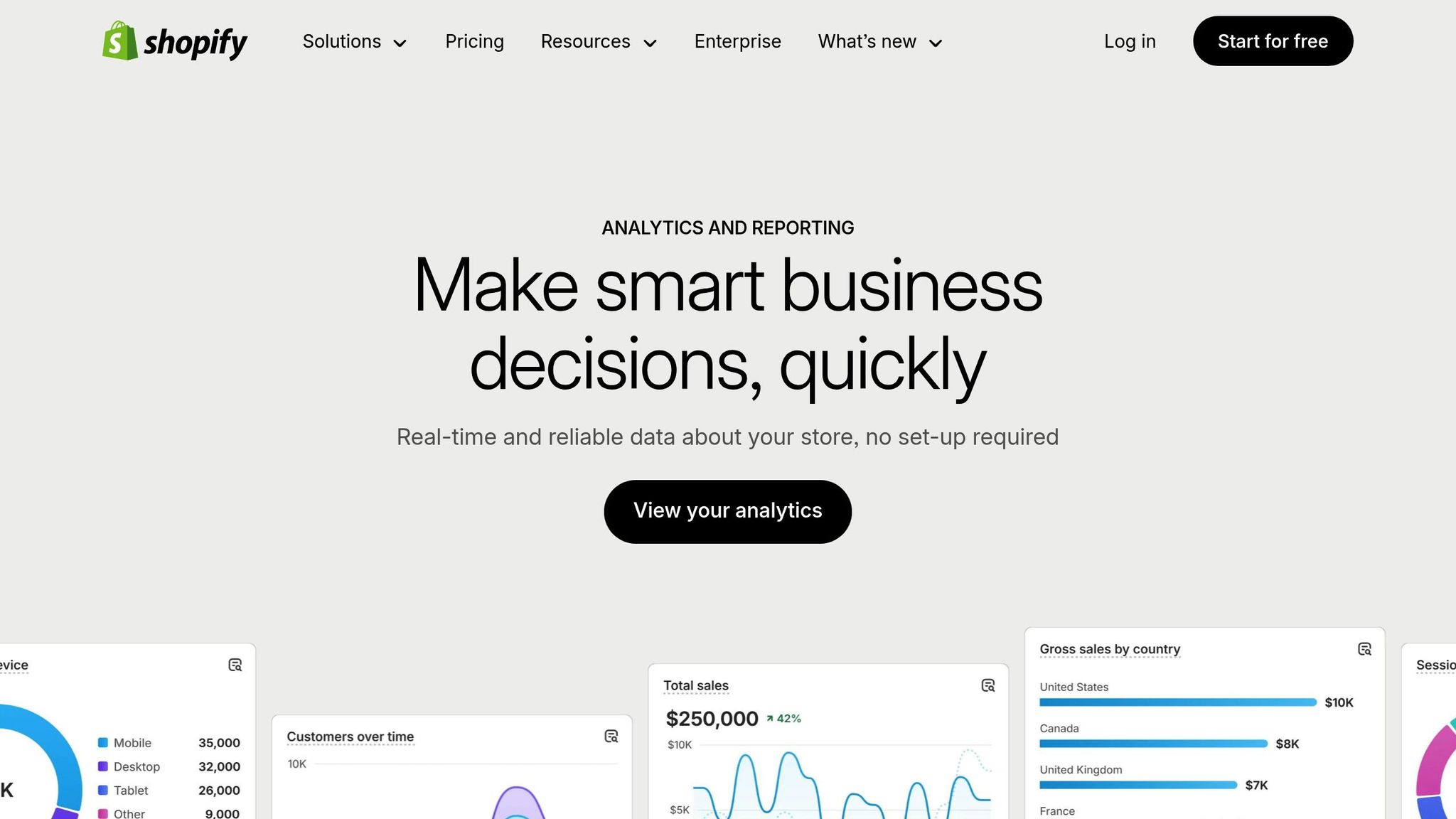
After setting your budget and choosing platforms, Shopify Analytics becomes your go-to tool for tracking and refining your ad spend. Its real-time data lets you make quick, informed decisions without waiting for monthly performance reports. The marketing measurement feature provides a centralized view of your advertising efforts, including metrics like attribution, customer acquisition cost (CAC), and ROAS across all channels[5].
Ruby Friel, founder of Still Life Story, highlights the impact of leveraging Shopify's analytics:
"By using Shopify's analytics and reporting to identify best sellers and sales trends, we were able to grow our revenue year over year by 50% at Christmas."[5]
Custom dashboards can also help you stay on top of key metrics. Shelby Adams, Operations Manager at Cleverhood, shares:
"Creating custom dashboards lets us focus on our core product performance. It allows us to stay nimble and reactive."[5]
By tracking sales across different marketing platforms, you’ll gain a clear picture of which channels are driving the best results for your products[6]. This allows you to shift your budget from underperforming platforms to those delivering higher returns. Businesses using real-time sales analytics have reported making decisions 25% faster than those relying on delayed data[7].
Shopify also offers aggregated platform insights, allowing you to compare your performance to similar stores and fine-tune your strategy[5].
Targeting and Audience Segmentation
To get the most out of your Shopify ad spend, it's all about reaching the right people. Effective targeting can turn a campaign into a profit machine, while poor targeting can drain your budget fast. By using your existing customer data wisely, you can create audience segments that are more likely to convert.
Building and Refining Target Audiences
Your Shopify store is a goldmine of customer insights. Dive into your customer data to build detailed buyer personas. Use tracking tools like Meta Pixel or the Facebook Conversions API to monitor visitor behavior and create custom audiences. When defining your target audience, don’t stop at basic demographics. Take a closer look at psychographics - like interests, values, and lifestyles - as well as behavioral patterns, such as purchase frequency and brand loyalty. Also, consider how engaged they are with your content. Experimenting with different audience sizes can help you strike the perfect balance between reach and relevance. These steps are essential for crafting effective audience segments.
Audience Segmentation Techniques
You can break down your audience in several ways, including:
- Demographics: Age, gender, location, income level.
- Behavior: Purchase history, browsing habits, or how often they interact with your brand.
- Psychographics: Interests, values, and lifestyle choices.
Aaron Zack, the former vice president at Propeller Coffee Co., shared his approach:
"We look at customer segmentation analysis in terms of product mix, purchase rate, AOV, LTV, and abandoned cart rate to get an understanding of how people are making purchases or not." [8]
Propeller Coffee used this data to personalize product offerings and promotions based on customer location and behavior. The result? A 175% boost in email marketing conversions. Klaviyo suggests targeting no more than 5% of your total customer base and using two or more conditions to define your segments [9]. Once your segments are set, retargeting becomes a powerful tool to win back potential customers.
Retargeting Non-Converting Visitors
Not every visitor will make a purchase right away, but retargeting can help you bring them back. Build retargeting audiences based on specific actions, like viewing a product, adding something to their cart, or revisiting your site. Then, tailor your messaging to fit where they are in the buying journey. Targeted retargeting can deliver up to three times the revenue while reducing unsubscribe rates by half [9].
Keep testing and tweaking your audience segments to stay ahead of changing customer behavior. This ongoing refinement will ensure your targeting efforts remain effective.
sbb-itb-d7b5115
Ad Creatives and Landing Page Optimization
Your ad creatives are often the first interaction potential customers have with your brand, making them a critical factor in turning clicks into conversions. Equally important is your landing page - it needs to deliver on the promises your ad makes to maximize your return on ad spend. Just like fine-tuning your budget and targeting, refining your creatives and landing pages can significantly boost your ROI.
Creating Better Ad Creatives
Ad creatives need to grab attention and resonate with your audience. Start by identifying the challenges your customers face and showcase your product as the solution. Use visuals that are sharp and appealing, especially because 75% of Shopify traffic comes from mobile devices. This means your images and videos must look great on smaller screens [10].
Focus on highlighting benefits rather than just features. For instance, instead of saying, "Our jacket is made with waterproof material", try, "Stay dry during your morning commute." Words that inspire action, like "Exclusive", "Limited-Time", or "Transform Your Look", can create urgency. Pair these with strong calls to action like "Shop Now", "Get 50% Off Today", or "Claim Your Deal" to drive engagement [10].
Here’s an example: A cap shop used user-generated content and influencer partnerships to boost click-through rates by 40% and saw a 25% increase in conversions [10].
Different platforms call for unique strategies. On Facebook and Instagram, syncing your product catalog and retargeting cart abandoners can improve results. Instagram Reels and targeted Google Ads are great for reaching high-intent shoppers. Also, prioritize vertical videos for mobile users and use tools like Canva or Adobe Spark to create professional-looking visuals [10].
A/B Testing for Creative Elements
Testing your ad creatives is essential for improving performance. Even small tweaks can make a big difference. A/B testing allows you to compare two versions of an ad by changing one element at a time. Start with a clear hypothesis - like whether a casual photo might outperform a formal one, or if a shorter headline could drive more clicks.
For example, Carl Taylor, a Leadpages user, found that a casual image boosted conversion rates by over 75% compared to a formal photo [12]. Similarly, Jae Jun at Old School Value saw a modern image outperform a traditional one by 99.76% [12]. Even a simple headline change led to a noticeable improvement in conversions [12]. In another case, The Foundation increased conversions by 28% by removing an action-oriented headline from their video squeeze page [12].
Run these tests for at least one full business cycle - ideally two - to account for changes in customer behavior [11]. Make sure your sample size is large enough to produce reliable results, and be patient while analyzing the data to make informed decisions [14].
Landing Page and Checkout Optimization
While a great ad can win the click, your landing page has to deliver on its promise. For instance, if your ad promotes a 50% discount, make sure that offer is prominently displayed on your landing page.
Page speed is crucial. Use tools like TinyPNG to compress images and ensure fast loading times. Simplify the checkout process by removing unnecessary fields, offering a guest checkout option, and displaying security badges to build trust [10].
Here’s an example: Growth agency VaynerCommerce worked with health food brand POSSIBLE to test two versions of their snack bar landing page. A version featuring lifestyle videos, benefit-focused sections, and an "I want both" button led to a 9.91% increase in conversion rates and a 10.25% boost in revenue per visitor [13].
Adding progress indicators can also reassure customers by showing how many steps remain in the checkout process. Continuously test elements like headlines, call-to-action buttons, images, and social proof to see what works best [13]. Frameworks like ICE (Impact, Confidence, Ease) can help you decide which tests to prioritize [12]. Keep in mind that A/B testing is not a one-and-done process; it requires ongoing adjustments to stay aligned with changing customer preferences [13].
Performance Tracking and Improvement
Once your ad creatives and landing pages are fine-tuned, the next step is to monitor their performance and refine your campaigns. Launching ads is just the beginning - the real work lies in tracking results and making adjustments. Without proper monitoring, your budget could be wasted. The secret? Understand the right metrics, interpret the data effectively, and know when to pivot.
Key Metrics to Monitor
Skip vanity metrics and focus on those that directly impact conversions and growth [15]. Here are the ones that matter most:
- Return on Ad Spend (ROAS): This tells you how much revenue is generated for every dollar spent on ads. A 2:1 ROAS is considered solid, while anything above 5:1 is exceptional [1]. For context, Klaviyo reports a 45x ROI for many eCommerce stores [2].
- Cost Per Acquisition (CAC): This measures how much it costs to bring in a new customer. Similarly, Cost Per Lead (CPL) tracks the expense of generating a lead [16].
- Customer Lifetime Value (CLV): This metric helps you understand the long-term value of your customers, guiding smarter decisions on ad spend.
- Conversion Rate: This shows the percentage of visitors completing a desired action, like making a purchase or signing up for a newsletter. Paired with click-through rates, it reveals how well your ads are moving prospects through the funnel.
Businesses that rely on data-driven marketing are six times more likely to see consistent profits year over year. Plus, 73% of consumers prefer brands that use data to deliver personalized experiences [15].
Using Data to Improve Campaigns
Platforms like Shopify analytics and Meta's Ads Manager are crucial for tracking ad performance [15]. These tools can help you identify what’s working and what needs tweaking.
Take Happy Hippo, a Shopify merchant, as an example. They achieved a 23% increase in sales from new customers, a 4.7x ROAS, and reduced their Cost Per Thousand (CPMs) by 51% after leveraging Shopify Audiences. This led to a 200% boost in conversion rates and a 72% drop in CAC [18]. Similarly, Mac Duggal used Shopify Plus Audiences to double their retargeting audience, cut retargeting costs by 3.6x, and achieve a 2x ROAS [18].
"At this very moment there is more emphasis on the ROI of individual campaigns and channels' contributions. Now we can typically see what a particular email campaign has achieved in lead generation, sales conversion, and even customer re-engagement. It makes it a bit easier to see what works and what needs tweaking than thinking of marketing as a collective outcome."
- Jay Soni, founder and marketing director at Yorkshire Fabric Shop [1]
Real-time ROI tracking lets you quickly adjust underperforming ads. If a campaign isn’t hitting its ROAS targets, pause it and reallocate the budget to more effective ones. Use A/B testing to find winning combinations and build dashboards to track trends and outliers [2].
Attribution has also evolved. As Jose Gallegos, founder of Jose Angelo Studios, explains:
"The game of marketing ROI calculation has dramatically shifted toward multi-touch attribution. When I began 10 years ago, we mainly focused on last-click attribution. Now, my team tracks micro-conversions along the customer journey. For example, we recently mapped a customer's 12 touchpoints across six months before their $50,000 software purchase, revealing that early stage content played a much bigger role than previously credited."
- Jose Gallegos [1]
These insights make continuous testing and agile adjustments more effective.
Regular Testing and Adjustments
Optimization is a never-ending process. To keep campaigns performing at their best, you need a regular schedule for reviews and data-driven updates.
Whether you review weekly, monthly, or quarterly, these check-ins allow for quick fixes and long-term improvements [17]. When testing, change one element at a time to isolate its impact. Run tests until you gather at least 100 conversions per variation to ensure accuracy [20].
Since only 2–4% of first-time visitors convert, retargeting is critical. Use email, SMS, and ads to re-engage these visitors across multiple channels [20]. When scaling successful campaigns, increase budgets incrementally - by 20–30% at a time - and monitor results to give algorithms time to adapt [20]. To prevent ad fatigue, refresh your creative assets regularly, updating at least 20% every 2–4 weeks [20].
"Optimization is about making small, incremental improvements over time that add up to significant performance gains."
- Google's research on campaign optimization [20]
Double down on strategies that work. Invest more in high-performing channels and audiences while pulling back on underperforming ones [1][19]. As Arham Khan, CEO of Pixated, puts it:
"Marketing ROI isn't a destination; it's a journey of constant refinement. So I'd say, Stay curious. Test relentlessly. Be willing to challenge yourself and remember that data can give you insights, but it's your job to understand the narrative beneath the numbers."
- Arham Khan [1]
The focus on metrics like ROAS and CAC has grown, reflecting a shift toward efficiency over unchecked growth. Meghan Hardy, founder of Happening Ideas, notes:
"Over the last few years, businesses have started emphasizing heavily on metrics like ROAS and CAC. The investors have prioritized efficiency over growth at all costs, and brands have been forced to do the same."
- Meghan Hardy [1]
This means every change should aim for profitable growth, not just expansion. Tools like Onramp Funds offer equity-free financing, helping brands quickly scale budgets for high-performing campaigns. With access to the right capital, you can seize opportunities and accelerate growth when it matters most.
Conclusion and Key Takeaways
Maximizing ROI for Shopify ad campaigns means taking a thoughtful and strategic approach in several key areas. Start with smart budget allocation - dedicating 10–15% of your revenue to advertising is a solid baseline. From there, adjust based on performance data to strike the right balance between spending enough to see results and keeping your resources in check [23].
Next, focus on audience targeting and segmentation. Begin with a broad audience and fine-tune based on behavioral insights. Since only 2–4% of first-time visitors typically convert [23], retargeting becomes essential. Personalized ads and exclusive discounts for these visitors can increase conversions by up to 30% [21].
Creative and landing page optimization are equally important. Ensure your landing pages load quickly and offer a smooth checkout experience. With U.S. mobile retail e-commerce expected to hit $710 billion by 2025, having mobile-friendly pages is non-negotiable [23].
Consistent testing and performance tracking are what set successful campaigns apart. Keep an eye on key metrics like ROAS, conversion rates, and cost per acquisition [21][22]. Regular A/B testing of your ad creatives, audience segments, and landing pages ensures your campaigns stay relevant and effective.
Another critical factor is adopting multi-channel strategies. Instead of relying on just one platform, spread your efforts across multiple channels. This approach, combined with consistent tracking and optimization, helps build a robust advertising strategy [21][22].
Finally, having access to quick and flexible funding can make all the difference when scaling your efforts. Onramp Funds offers revenue-based financing tailored for eCommerce businesses. With funding tied to your sales and available within 24 hours, you can scale campaigns without worrying about cash flow constraints.
The key takeaway? Treat optimization as a continuous process. Set clear ROAS goals, use data to guide your decisions, and scale with confidence as your performance metrics justify further investment. Sustainable growth isn’t a one-time effort - it’s an ongoing commitment to refining and improving at every step.
FAQs
How can I use Shopify Analytics to optimize my ad spend and increase ROI?
To make the most of your ad budget and improve ROI with Shopify Analytics, keep an eye on key metrics like customer lifetime value (CLV), product profit margins, and ad spend by SKU. These data points give you a clear picture of where your money is going and help you allocate it more effectively.
Shopify's Overview Dashboard provides a quick look at your sales, traffic, and conversion rates. This makes it simple to identify trends and spot your best-performing products. For deeper insights, you can pair Shopify with advanced tools that dig into profit margins and customer behavior. This combination allows you to refine your ad strategy - pausing campaigns that aren’t delivering and doubling down on the ones that are.
By keeping these metrics front and center and adjusting your strategy as needed, you’ll be in a strong position to get the most out of every dollar spent on advertising.
What are the best ways to segment and target your audience for better Shopify ad performance?
To make the most of your Shopify ads, start by building detailed customer profiles. Focus on key details like age, gender, income, and location. This helps you understand who your audience is and craft messages that resonate with them.
Lean on data-driven strategies to maximize your reach. For example, use lookalike audiences to find new customers who share similar traits with your current ones. Retargeting is another powerful tool - focus on high-intent visitors, like those who added items to their cart but didn’t complete the purchase. These efforts can lead to a better return on investment.
Lastly, break your audience into smaller segments and keep an eye on performance metrics for each group. This approach lets you fine-tune your campaigns, spend your ad budget more wisely, and zero in on strategies that work best.
When should I adjust my ad budget across different advertising channels?
When certain advertising channels aren't pulling their weight in terms of return on investment (ROI), or when top-performing ones show potential for even better results with extra funding, it’s time to rethink your ad budget. Shifting funds strategically helps you get the most out of every dollar spent.
Budget adjustments also make sense when you’re rolling out a new campaign, aiming at a fresh audience, or adapting to seasonal patterns. Keeping a close eye on performance metrics - like click-through rates and conversion rates - can reveal where to scale up or cut back. Making decisions based on data ensures you're optimizing your advertising efforts effectively.
Related Blog Posts
Onramp Funds
Funding built around your sales
Connect your store and see what you qualify for. Repay as a percentage of sales, with no personal credit check.
Funding in as little as 24 hours.
