


Revenue-based repayment is a flexible funding option for businesses, especially eCommerce sellers. Instead of fixed monthly payments, you repay a percentage of your revenue, so payments adjust based on your sales performance. Here’s what you need to know:
- How It Works: Borrow funds upfront and repay using 4%-8% of your monthly revenue.
- Key Benefits:
- Payments decrease during slow months and increase during high sales periods.
- No need for collateral or high credit scores.
- Retain full ownership of your business (no equity loss).
- Repayment Cap: Total repayment ranges from 1.5 to 3 times the amount borrowed.
- Duration: Repayment adapts to your sales trends, typically lasting 1-3 years.
| Feature | Revenue-Based Repayment | Traditional Loans |
|---|---|---|
| Payment Flexibility | Adjusts with revenue | Fixed monthly payments |
| Credit/Collateral Needed | Minimal requirements | High credit/collateral needed |
| Ownership Impact | Retain full ownership | May require equity |
| Default Risk | Lower (payments adjust) | Higher (fixed payments) |
This model is ideal for eCommerce businesses with seasonal sales, offering easier cash flow management. Platforms like Onramp Funds are one example. With Onramp Funds, funds typically arrive in one to two business days.
Revenue-Based Financing: What Is It, and How Does It Work?
Core Payment Mechanics
Revenue-based repayment offers a flexible way to manage payments by tying them directly to your sales, helping to smooth out cash flow challenges.
Payment Calculations
With this approach, a fixed percentage of your gross monthly revenue - typically between 4% and 8% - is used to determine your payment amount[3]. This means your payments will fluctuate in line with your sales performance.
| Revenue Level | Monthly Revenue | Payment % | Monthly Payment |
|---|---|---|---|
| High Season | $100,000 | 6% | $6,000 |
| Average Month | $60,000 | 6% | $3,600 |
| Low Season | $30,000 | 6% | $1,800 |
Once calculated, these payments are automatically deducted on a predetermined schedule.
Payment Timing
Payments are processed automatically through your eCommerce platform on the 15th of each month. They are based on the revenue generated during the prior month[4].
Payment Limits and Duration
Understanding repayment limits is key to managing overall costs. Revenue-based repayment includes a repayment cap, which usually falls between 1.5 and 3 times the original funding amount[2]. This cap ensures you know the maximum cost upfront while allowing repayment to adjust to your business's performance.
The repayment timeline adapts to your sales trends: higher sales lead to quicker repayment, while lower sales extend the timeline. This structure aligns repayment with your business's seasonal cycles, offering flexibility during slower periods.
Main Advantages for eCommerce Sellers
Revenue-based financing (RBF) offers eCommerce sellers a repayment model that adapts to their sales patterns, providing flexibility and aligning with the natural rhythm of their business.
Seasonal Payment Adjustments
One standout benefit is how repayments adjust during slower sales periods. For instance, if your monthly revenue dips from $100,000 to $30,000, your payments decrease proportionally to match the reduced income [6]. This means you’re not locked into hefty payments during off-peak seasons.
"RBF aligns with your business's natural ebb and flow, allowing for proportional repayments, which can be advantageous during slow months. However, this can mean significantly higher financial obligations during peak seasons." - Hahnbeck [1]
Variable Payment Structure
The flexibility of RBF lies in its variable payment model. Payments are tied directly to your revenue, so during months of lower sales, your financial obligations decrease. This eliminates the stress of fixed payments when sales are unpredictable [5].
| Aspect | Traditional Fixed Payments | Revenue-Based Payments | Impact |
|---|---|---|---|
| Payment Amount | Fixed monthly payment, no matter revenue | Percentage of actual revenue | Easier cash flow management |
| Risk Level | High obligation during slow periods | Aligned with business performance | Lower risk of default |
| Flexibility | Rigid payment schedule | Adjusts to sales fluctuations | Greater operational freedom |
This approach not only makes cash flow easier to manage but also minimizes the risk of default. It allows businesses to focus on growth without the strain of rigid financial commitments.
Business Growth Options
RBF doesn’t just ease financial pressure - it also opens doors for strategic growth. Sellers can access capital quickly and use it where it counts the most, all while keeping full ownership of their business. Key benefits include:
- Freedom to allocate resources across different business needs
- Retention of full ownership without giving up equity
sbb-itb-d7b5115
Getting Started with Onramp Funds
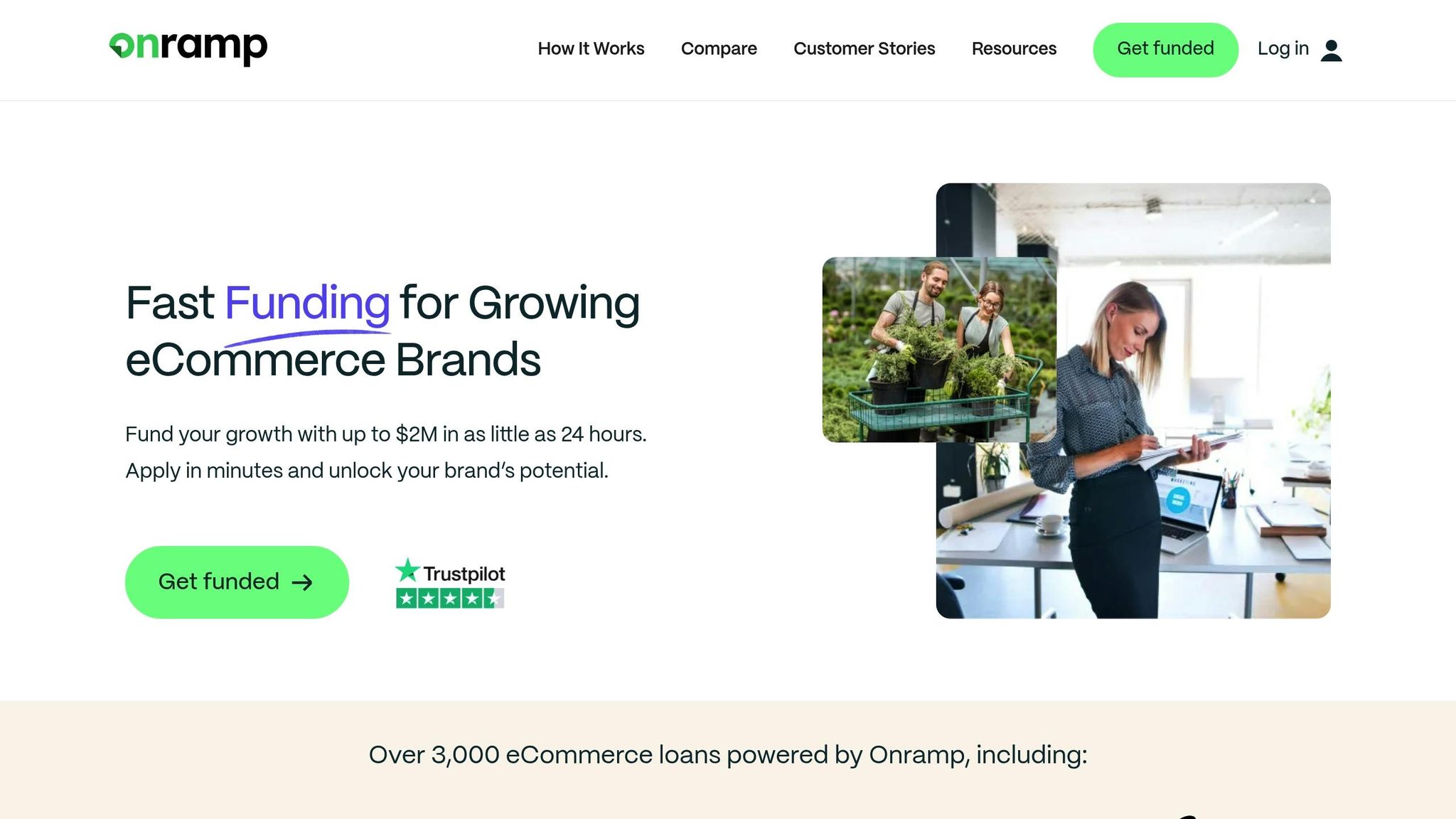
Requirements and Application Steps
Onramp Funds has a couple of basic requirements:
- Your eCommerce business must have $10,000 in average monthly sales and 6 months of selling history.
- Your business must be a legal US business entity.
Once you meet these criteria, here’s how it works:
- Step 1: Use the funding calculator.
- Step 2: Link your eCommerce platform.
- Step 3: Receive your funds. With Onramp Funds, funds typically arrive in one to two business days.
Once approved, you can integrate your store with Onramp Funds for automated repayment.
"Applied, got our offer, and had cash in our bank account within 24 hours. Their Austin, TX based team was very professional and helped me deploy the cash to effectively grow our business." - Nick James, CEO Rockless Table [7]
Platform Connections
Onramp Funds supports 10 platforms. Here’s a breakdown of supported platforms:
| Platform Type | Supported Marketplaces |
|---|---|
| Direct Sales | Shopify, BigCommerce, WooCommerce, Squarespace |
| Marketplaces | Amazon, Walmart Marketplace, eBay |
| Social Commerce | TikTok Shop |
| International | SHOPLINE |
| Payments | Stripe |
Support and Fee Structure
Onramp Funds charges a fee as low as 9% of the funded amount ($4,500 on $50,000), flat, disclosed upfront, non-compounding, longer terms cost more. Subject to credit eligibility; rates and terms may vary.
"Onramp offered the perfect solution with revenue-based financing to secure the capital we needed to invest in inventory and pay it back at a reasonable time frame once we made sales. The process was quick, easy, and the support was great." - Jeremy, Founder and Owner of Kindfolk Yoga [7]
Onramp Funds requires no personal credit check to see an offer, and funding is sized to your combined sales, stated in your offer.
Conclusion
Recap of Key Benefits
Revenue-based repayment stands out as a practical funding solution for eCommerce businesses. Its main perks include payments that adjust automatically with sales, offering protection for cash flow during seasonal ups and downs, and the ability to retain full ownership without giving up equity.
The growing popularity of this model highlights its value, with projections showing increased adoption across the eCommerce world. This trend underscores how well it aligns with the funding needs of modern businesses.
With these benefits in mind, the next step is to explore your funding options.
Connect with Onramp Funds
With Onramp Funds, funds typically arrive in one to two business days.
| Contact Method | Details |
|---|---|
| Online Calculator | Use the tool at onrampfunds.com to estimate your funding potential. |
| Platform Support | 10 platforms: Amazon, Shopify, Walmart, TikTok Shop, eBay, BigCommerce, WooCommerce, Squarespace, Shopline, and Stripe. |
| Minimum Requirement | $10,000 in average monthly sales and 6 months of selling history, plus a legal US business entity. |
FAQs
What makes revenue-based repayment a flexible option for eCommerce businesses compared to traditional loans**?**
Revenue-based repayment provides eCommerce businesses with a flexible way to handle financing by linking repayments to a percentage of their sales. With this model, payments automatically adjust based on your revenue – higher sales mean larger payments, while slower sales result in smaller ones. This setup can be especially helpful for managing cash flow during seasonal highs and lows or periods of reduced activity. This type of financing model is ideal for online businesses using platforms like Shopify or Amazon, where monthly revenue can fluctuate dramatically. Unlike traditional loans, which demand fixed monthly payments regardless of how your business is performing, revenue-based financing eases financial strain and lowers risk. Plus, it usually doesn’t require personal guarantees or collateral, making it a less risky and more flexible option for growing your eCommerce business. It also offers a non-dilutive alternative to venture capital or equity financing, allowing business owners to maintain full control while accessing working capital.
What do I need to qualify for revenue-based funding with Onramp Funds?
To be eligible for revenue-based funding with Onramp Funds, your business needs to meet a few essential requirements:
- Monthly Sales: Maintain $10,000 in average monthly sales.
- Legal Registration: Be a legal US business entity.
- Operating History: Have 6 months of selling history.
Onramp Funds requires no personal credit check to see an offer. Once approved, repayment can be a share of daily sales, a fixed schedule over 1 to 12 months, or a rolling cash line.
What is a repayment cap in revenue-based financing**, and how does it impact total** repayment costs?
In revenue-based financing (RBF), the repayment cap represents the maximum amount a business commits to paying back. This includes the original funding plus any fees. Typically, this cap falls between 1.5 to 2.5 times the borrowed amount. Payments are tied to a percentage of your monthly revenue, meaning they fluctuate with your earnings – higher revenues lead to larger payments, while lower revenues reduce the payment amount. This setup provides flexibility, making it easier to manage cash flow. The repayment cap ensures cost predictability, even if your repayment schedule extends during slower months, unlike traditional loans where interest rates can compound over time. When analyzing the total repayment cost, it’s essential to factor in both the repayment cap and your revenue forecasts. Strong revenue months can help you repay faster, while slower months may extend the repayment period. By keeping these elements in mind, you can better plan for repayments without straining your financial stability. This makes RBF a smart type of financing for entrepreneurs who want scalable repayment terms based on real business performance rather than fixed debt financing structures.
Related Blog Posts
Onramp Funds
Funding built around your sales
Connect your store and see what you qualify for. Repay as a percentage of sales, with no personal credit check.
Funding in as little as 24 hours.
