

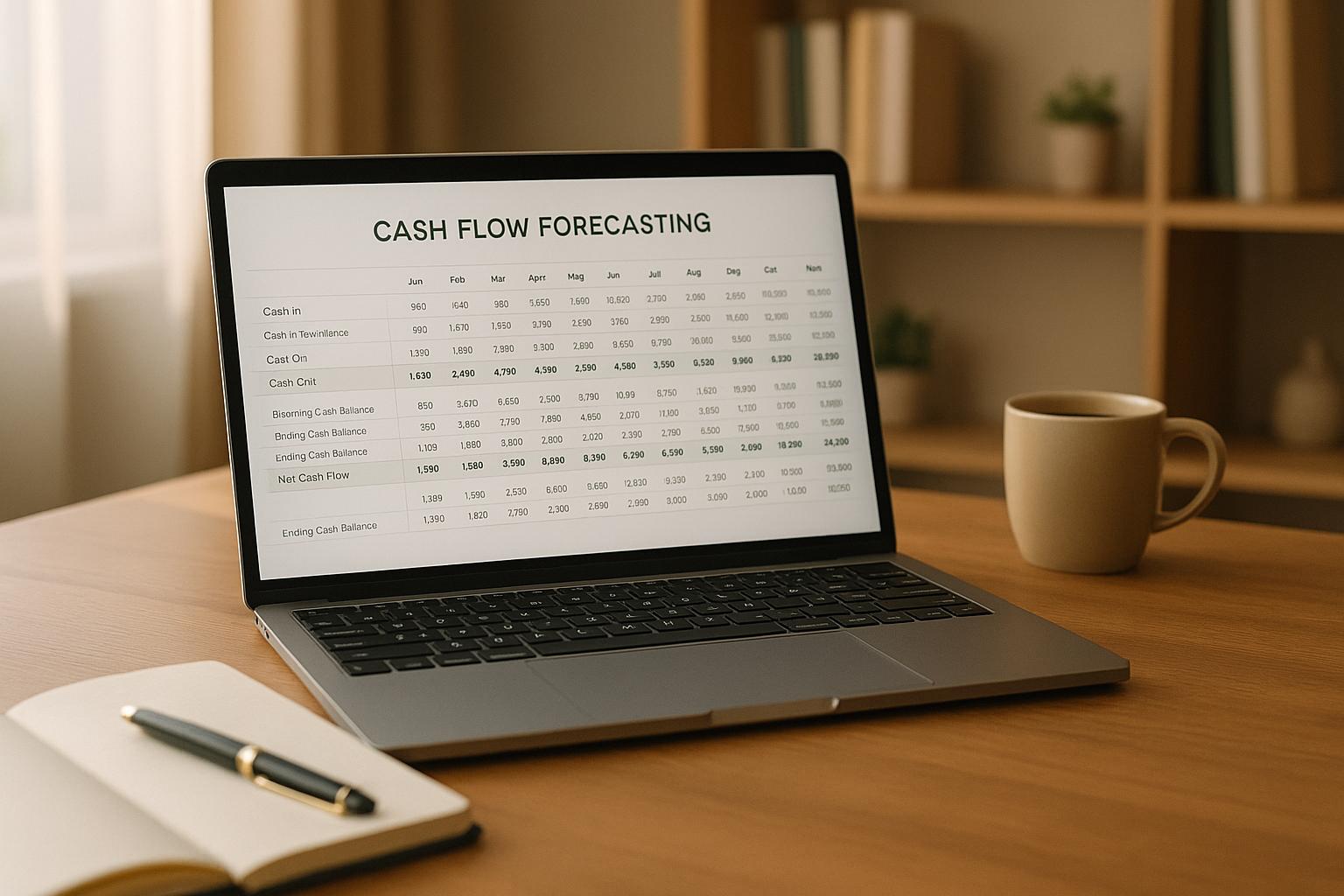
Cash flow forecasting helps eCommerce businesses predict their future cash inflows and outflows. This process is critical because it ensures you can cover expenses, plan for growth, and avoid financial pitfalls. Without proper forecasting, even profitable businesses can face cash shortages due to delayed payments, seasonal fluctuations, or unexpected costs.
Why it matters:
- 82% of small businesses fail due to cash flow issues.
- Seasonal sales spikes (e.g., Black Friday) require planning for inventory and expenses in advance.
- Payment processors may delay funds, and returns can unexpectedly reduce cash reserves.
Key components of a forecast:
- Cash inflows: Track revenue from all sales channels (e.g., website, marketplaces).
- Cash outflows: Monitor fixed (e.g., rent, software) and variable (e.g., inventory, shipping) costs.
- Scenario planning: Prepare for optimistic, realistic, and conservative outcomes.
Steps to create a forecast:
- Determine your starting cash balance.
- Estimate monthly inflows (sales, deposits) and outflows (expenses, taxes).
- Calculate your net cash flow and ending balance.
Tools to simplify forecasting:
- Accounting platforms with forecasting features.
- Dedicated cash flow software for real-time insights and scenario modeling.
- Financing options like Onramp Funds for cash flow gaps.
Regularly updating your forecast and comparing it to actual results ensures accuracy and helps you adjust for seasonal trends or unexpected changes. With reliable forecasts, you can confidently plan for growth, manage cash flow gaps, and maintain financial stability.
Cash Flow Forecast Template and Walkthrough for E-Commerce/Inventory Based Business
Key Parts of an eCommerce Cash Flow Forecast
When creating an eCommerce cash flow forecast, it's essential to focus on three main elements: the money coming in, the money going out, and how these flows might shift under various circumstances. Keeping a close eye on these components ensures your forecast mirrors your actual financial situation.
Cash Inflows: What to Track
Start by consistently tracking all your revenue sources. This means capturing sales data from your website, online marketplaces, and even social media platforms [4]. It's important to remember that different payment methods come with varying processing times, which can impact when funds are available. To maintain accuracy, integrate data from every sales channel into your forecast [4].
Cash Outflows: Understanding Your Expenses
On the expense side, monitor both fixed and variable costs. Fixed expenses, like software subscriptions, warehouse rent, and insurance premiums, are usually predictable. Variable costs, however, fluctuate based on business activity and include things like advertising expenses, inventory purchases, and shipping costs [4].
If you're selling physical products, inventory management becomes a critical piece of the puzzle. This involves tracking the cost of goods sold (COGS), monitoring stock levels, and keeping tabs on inventory value [4]. Additionally, staying compliant with sales tax laws is crucial. This means understanding nexus regulations, calculating and collecting the correct taxes, and submitting them to the appropriate state authorities [4].
Planning for Different Scenarios
Prepare for a range of outcomes by developing optimistic, realistic, and conservative scenarios. For instance, an optimistic scenario might assume a surge in sales, while a conservative one accounts for potential downturns. The realistic scenario, often based on historical data and current trends, serves as your baseline.
Cash flow forecasting tools can help you quickly adjust assumptions and project how changes might affect your overall cash position [3]. If you're operating internationally, managing foreign currency transactions is particularly important, as exchange rate fluctuations can significantly impact your cash flow [4]. Don’t forget to account for one-time events that might require upfront investments, ensuring your forecast includes all potential cash needs. These strategies help you build a well-rounded and reliable cash flow forecast.
How to Build a Cash Flow Forecast: Step-by-Step Guide
Creating a cash flow forecast might sound daunting at first, but breaking it into manageable steps makes the process much simpler. As Michael Keenan explains, "Cash flow forecasting helps business owners understand how much money is flowing through their company, which can help them plan for growth" [2]. This guide walks you through the process, helping you take control of your cash flow and plan strategically.
Step 1: Find Your Starting Cash Balance
Your starting cash balance is the bedrock of your forecast. It’s the amount of cash you have on hand at the beginning of the forecasting period. To find this figure, check your bank statements and payment processor balances. Be sure to exclude receivables or inventory, as they aren’t liquid cash.
If you’re a new business, your starting balance might come from your initial investment or what’s left after covering startup costs. For established businesses, use the ending balance from your last forecast as the starting point for the new period.
Step 2: Estimate Your Cash Inflows and Outflows
The next step is to estimate the money flowing in and out of your business. Use past financial data to create realistic projections for both inflows and outflows.
For inflows, list the income you expect to generate each month, broken down by type. For example, eCommerce conversion rates by the end of 2023 averaged 2.1% across major industries, with food and beverage reaching up to 3.7% [5]. Use these benchmarks along with your historical data to guide your sales forecasts.
For outflows, account for all expenses, including fixed costs like payroll, rent, and insurance, as well as variable costs like raw materials, commissions, and shipping. Don’t forget one-off expenses, annual subscriptions, insurance premiums, and estimated tax payments. Seasonal trends should also be factored in - many eCommerce businesses see spikes during holidays or back-to-school shopping seasons, followed by slower periods.
Here’s an example of a basic cash flow forecast:
| Category | January | February | March |
|---|---|---|---|
| 1. Beginning cash balance | $5,000 | $15,000 | $4,000 |
| Account receivables | $40,000 | $30,000 | $35,000 |
| Customer cash deposits | $12,000 | $5,000 | $3,000 |
| 2. Total inflows | $52,000 | $35,000 | $38,000 |
| Payroll + taxes | $15,000 | $15,000 | $15,000 |
| Vendor payments | $10,000 | $13,000 | $20,000 |
| Rent | $5,500 | $5,500 | $5,500 |
| Loan payments | $4,500 | $4,500 | $4,500 |
| Other overheads | $7,000 | $5,000 | $6,000 |
| 3. Outflows | $42,000 | $43,000 | $51,000 |
| 4. Ending cash balance | $15,000 | $7,000 | ($9,000) |
Step 3: Calculate Your Net Cash Flow and Ending Balance
Now, it’s time to put it all together. Subtract your total outflows from your inflows to calculate your net cash flow. Then, add this figure to your starting balance to determine your ending cash balance.
A positive net cash flow means you’re bringing in more cash than you’re spending, while a negative net cash flow signals a potential shortfall. The ending balance shows how much cash you’ll have left at the end of the period. This step is critical, especially since cash flow issues contribute to 82% of business failures in the U.S. [5].
By forecasting these numbers ahead of time, you can spot potential cash shortages before they become major problems. Be conservative in your estimates - it’s safer to overestimate expenses and underestimate income than to face unexpected deficits. Aim for a rolling 12-month cash flow forecast to keep your planning as accurate as possible.
If you notice a negative cash flow, consider adjusting payment terms, encouraging early payments, or exploring revenue-based financing options. By following this structured approach, you’ll be better equipped to manage your cash flow and steer your business toward growth.
sbb-itb-d7b5115
Tools for Cash Flow Forecasting
Using the right tools can simplify cash flow forecasting and offer real-time insights. With finance teams that implement automation achieving 40% faster cash flow projections [8], adopting suitable technology becomes a key factor for success in eCommerce. The goal is to find tools that integrate smoothly with your current systems while delivering the precision and adaptability your business requires.
Connecting eCommerce Platforms with Forecasting Tools
For multi-channel eCommerce businesses, integrating platforms with forecasting tools is critical. For instance, Shopify Marketplace Connect enables sellers to manage listings, orders, and inventory across major marketplaces directly within Shopify [12]. This centralized solution streamlines data collection, consolidating sales information from multiple channels into one place, making cash flow forecasting more efficient.
Integration capabilities, however, can vary widely between tools. Many accounting and analytics platforms come with built-in forecasting features and automation, though they may lack the flexibility of custom spreadsheets [9]. These tools are ideal for businesses that prefer straightforward, pre-built forecasting options.
On the other hand, dedicated cash flow software offers advanced features like real-time integration and automated reporting [9]. Many of these tools also include scenario planning, allowing businesses to model different financial outcomes before making big decisions. For example, CashFlowTool, rated as the #1 cash flow app on QuickBooks Marketplace [7], exemplifies this approach.
"Cash Flow Tool saves me about 20 hours a month in cash flow forecasting for my clients! I used to use complicated spreadsheets and never felt totally sure that my numbers were accurate." – MichelleAlchemy, CEO, Publish Your Gift® [7]
Cloud-based solutions bring additional advantages. They offer flexibility and make collaboration easier, which is particularly helpful for businesses with remote teams or multiple stakeholders involved in financial planning [10][11].
When evaluating forecasting tools, look for those with customizable reports and dashboards to monitor key performance indicators (KPIs) [9]. As your business grows, these features become essential for tracking the specific metrics that influence cash flow.
By using automated tools, you can better prepare for cash flow gaps - where strategic financing can make a significant difference.
How Onramp Funds Helps with Cash Flow Management
Once forecasting tools identify cash flow gaps, Onramp Funds steps in to provide quick, equity-free financing tailored specifically for eCommerce businesses. The platform integrates with major sales channels to analyze your data and offer funding within 24 hours.
Onramp Funds uses a revenue-based financing model, where repayments adjust in line with your sales performance. Instead of fixed monthly payments that can strain your cash flow during slower periods, you repay a percentage of your sales. This setup accommodates the seasonal ups and downs common in eCommerce.
For businesses generating at least $10,000 in monthly sales, Onramp Funds offers transparent fee structures ranging from 2–8%, with no hidden charges. A funding calculator on their platform provides instant estimates, giving you a clear picture of your financing options before committing.
Beyond funding, Onramp Funds provides personalized support from their Austin-based team, helping you use the capital effectively. Whether you need to stock up on inventory for peak seasons, invest in marketing, or manage cash flow gaps, their flexible financing solutions often outperform traditional banks.
By combining forecasting tools with accessible financing, businesses can take a more comprehensive approach to managing cash flow. Forecasting tools help pinpoint when and where challenges might arise, while Onramp Funds delivers the capital needed to address those gaps and seize growth opportunities.
With 30% of business failures attributed to running out of money [8], the combination of accurate forecasting and flexible funding is essential for long-term success. Leveraging both predictive tools and tailored financing ensures eCommerce businesses can maintain steady cash flow while pursuing ambitious growth strategies.
Best Practices for Cash Flow Forecasting
To keep your cash flow forecasts useful and reliable, it's crucial to update them regularly. The best eCommerce businesses approach forecasting as an ongoing process, adjusting for new sales figures, expenses, and market trends. Here’s how you can refine your cash flow predictions and make them work for your business.
Update Your Forecasts Regularly
Frequent updates - ideally every week - are key to maintaining accurate forecasts. By incorporating the latest sales data, expenses, and market insights, you can ensure your projections remain relevant. Automation can make this process even more efficient. Take Peak Toolworks, for example. By automating their forecasting, they saved significant time and improved accuracy. Ben Stilwell, CFO at Peak Toolworks, shared:
"Our process has improved dramatically, and we have a cash forecast complete by the end of the first business day of the week, versus the 4th day, and we are 100% sure of the accuracy." [13]
This shows how automation not only saves time but also enhances confidence in your numbers. Using rolling forecasts is another way to stay aligned with current business realities. When updating your forecasts, focus on realistic assumptions and include annual payments, tax obligations, and other known expenses [2]. For tips on handling seasonal trends, check out the next section. It’s also smart to prepare for different scenarios - best, moderate, and worst-case - to cover all your bases [14].
After updating your forecasts, compare them to actual results to refine your process further.
Compare Forecasts with Actual Results
The real value of forecasting lies in how closely your predictions match actual performance. By regularly comparing the two, you can spot patterns in accuracy and identify areas where adjustments are needed [6]. Ask yourself questions like: Are your expense estimates on target? Were there unexpected changes? Did any surprises affect your cash flow? These reflections help fine-tune future forecasts [6].
This process also reveals biases in your assumptions. For instance, if actual cash flow consistently exceeds your forecast, it might signal opportunities for growth. On the flip side, falling short of predictions could mean it’s time to revise your plans before bigger issues arise [15]. Regular evaluations not only improve your current cash management but also sharpen your forecasting skills [6].
Account for Seasonal Changes and Market Shifts
Seasonal patterns and market changes can greatly impact your cash flow, so it’s important to account for them in your forecasts. Many eCommerce businesses see predictable seasonal trends - like a sales spike in the fourth quarter followed by a slowdown in the early months of the year. Reflecting these patterns in your forecasts ensures they stay realistic [2].
At the same time, be prepared for unexpected market changes, such as supply chain disruptions or fluctuating advertising costs. Flexible scenario models can help you adjust quickly. Don’t forget to consider factors like extra pay periods (e.g., years with 27 biweekly pay cycles instead of 26), quarterly tax payments, or annual software renewals. These details can make a big difference in keeping your forecasts accurate [2].
Why Cash Flow Forecasting Matters for Your eCommerce Business
Now that we've broken down the components and process of cash flow forecasting, let's talk about why it plays such a vital role in the success of your eCommerce business. According to a study by Intuit, 61% of small businesses face challenges with cash flow - a statistic that underscores how essential forecasting is for staying ahead in unpredictable markets [17].
At its core, cash flow forecasting transforms uncertainty into actionable insights. With a solid forecast in hand, you can make smarter decisions across every aspect of your business. Ariel Gottfeld from Cash Flow Frog puts it this way:
"A cash flow forecast offers a precise view of money entering and leaving your business over a set timeframe. Without it, planning for your business operations becomes challenging. A forecast helps you spot potential cash shortfalls and allows for better strategic planning, ensuring financial stability." [16]
This clarity isn’t just theoretical - it directly affects how you manage your business. By knowing your future inflows and outflows, you can confidently plan for growth. Whether it’s expanding your product range, investing in marketing, or stocking up for peak seasons, a reliable forecast ensures your spending aligns with your long-term goals [3, 30].
Beyond planning, forecasting acts as an early warning system. It helps you identify potential cash shortages before they turn into major problems. Spotting these gaps early means you can adjust expenses, speed up collections, or explore solutions like revenue-based financing from Onramp Funds to bridge the gap [1].
FAQs
What’s the best way for eCommerce businesses to manage cash flow during busy seasons like Black Friday?
Managing cash flow during high-demand periods like Black Friday calls for thoughtful preparation and smart financial tactics. Start by preparing a cash flow forecast to map out your expected income and expenses for the season. This tool helps you spot potential gaps and allocate your funds where they’re needed most.
You might also explore revenue-based financing. With this option, repayments adjust according to your sales, offering flexibility during both busy and slower times. At the same time, keep a close eye on your inventory levels - strike a balance to avoid overstocking or running out of your best-sellers. You can also negotiate extended payment terms with suppliers to keep cash on hand for other priorities.
Lastly, consider setting up a financial safety net, like a line of credit, to cover unexpected costs or delays. Combining these methods can help you maintain steady cash flow and make the most of peak shopping seasons.
What are the best practices for using cash flow forecasting tools with eCommerce platforms?
To make the most of cash flow forecasting tools for your eCommerce platform, start by choosing options that integrate smoothly with your current systems - think payment processors, bank accounts, and accounting software. This way, you’ll get real-time data updates and cut down on tedious manual tasks.
Focus on tools that work well with major platforms like Shopify, Amazon, or WooCommerce. Many of these tools now incorporate AI-powered insights, offering more precise predictions and helping you plan for future cash flow needs. Automating these tasks not only saves time but also gives you a clearer view of your financial standing, making it easier to make informed decisions as you grow your business.
For eCommerce sellers aiming to improve cash flow management, platforms like Onramp Funds provide tailored funding solutions. They offer quick, equity-free financing and flexible repayment terms tied to your sales performance, giving you the resources to invest in inventory, marketing, or other growth opportunities.
How can eCommerce businesses plan for unexpected market changes or financial challenges?
eCommerce businesses can brace themselves for unexpected market shifts or financial hurdles by practicing scenario planning. This means mapping out a variety of "what-if" situations - like a sudden sales slump, supply chain hiccups, or an unexpected surge in demand - and crafting strategies to tackle each one head-on.
By pinpointing possible risks and preparing in advance, businesses can manage resources more effectively, keep cash flow steady, and respond swiftly to changes. Taking this forward-thinking approach minimizes financial uncertainty and strengthens a business's ability to weather unpredictable market conditions.
Related Blog Posts
Onramp Funds
Funding built around your sales
Connect your store and see what you qualify for. Repay as a percentage of sales, with no personal credit check.
Funding in as little as 24 hours.
